
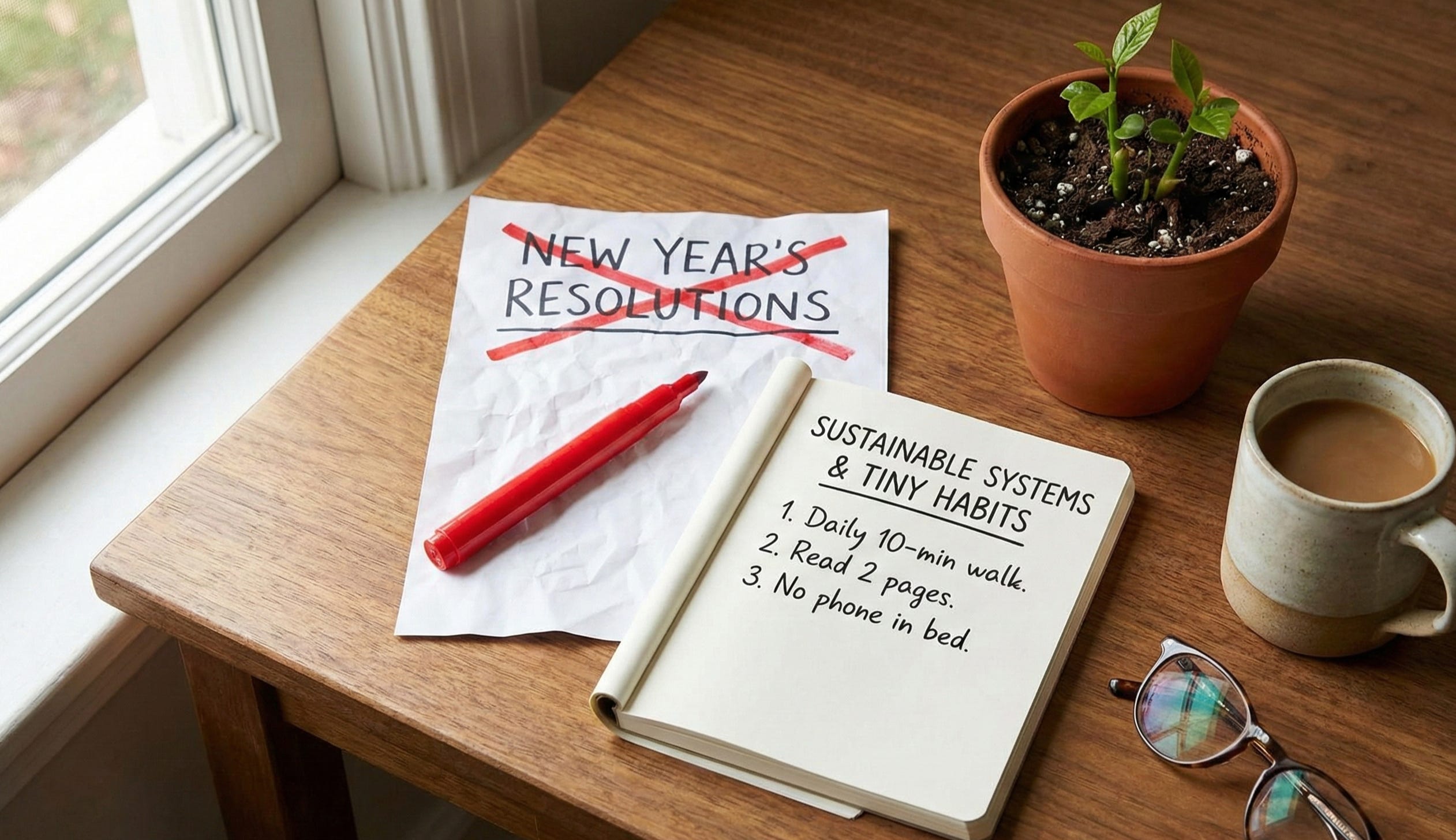
New Year, New You?
Top 5 Ways to Avoid Another Yearly Failure
Why New Year’s Resolutions Are a Trap (And What to Do Instead)
It’s that time of year again. The collective consciousness is buzzing with the promise of a “new you.” Gym memberships skyrocket, kale flies off the shelves, and millions of people finally declare their intentions to overhaul their lives on January 1st.
I’m here to tell you: Stop. Just stop.
The New Year’s resolution is a cultural ritual set up for failure. It’s a dopamine-fueled burst of optimism that usually crashes and burns before Valentine’s Day. Studies consistently show that a staggering percentage of resolutions fail—some suggest as high as 80% are abandoned by February.
Why? Because resolutions are often vague (”get healthy”), unrealistic (”lose 30 pounds in a month”), and rely almost entirely on willpower, which is a finite resource. They focus on the outcome—the shiny trophy at the finish line—without giving a second thought to the process required to get there. When the initial enthusiasm fades and life gets in the way, the resolution collapses under its own weight, leaving you with nothing but guilt and a sense of failure.
Real, lasting change isn’t the result of a grand, once-a-year declaration. It’s the product of small, consistent actions compounding over time. It’s boring, unsexy, and incredibly effective.
So, this year, I challenge you to ditch the resolution list. Instead, try one, or all, of these five evidence-based alternatives to build a better year—and a better life.
5 Things to Do Instead of a New Year’s Resolution
1. Focus on Systems, Not Goals
A goal is a specific objective, like “write a book.” A system is the process that leads to that objective, like “write for 30 minutes every morning at 7 AM.” Resolutions are almost always goals. The problem is, you can’t directly control achieving a goal. You can only control your actions.
Instead of setting a goal to lose 20 pounds, build a system of preparing healthy lunches every Sunday. Instead of resolving to read more, create a system of placing a book on your bedside table every night. Forget the finish line and obsess over the daily routine. As James Clear, author of Atomic Habits, says, “You do not rise to the level of your goals. You fall to the level of your systems.”
2. Embrace the Power of Micro-Habits
The biggest mistake people make is trying to do too much, too soon. Your brain is wired to resist drastic change. The antidote is to make the new behavior so small it’s impossible to fail.
Want to start exercising? Your micro-habit isn’t going to the gym for an hour; it’s doing two push-ups immediately after you wake up. Want to meditate? Start with one mindful breath before you open your email. These tiny actions seem insignificant, but they build the “muscle” of consistency. Once the habit is established, you can gradually increase the intensity. The key is to just show up.
3. Define Your “Anti-Goals”
Sometimes it’s easier to identify what you don’t want than what you do. An “anti-goal” is a clear statement of a negative outcome you want to avoid.
For example, an anti-goal for your work life might be: “I will not check my work email after 7 PM.” An anti-goal for your health could be: “I will not keep soda in the house.” By defining the boundaries and behaviors you want to eliminate, you naturally create space for better things to emerge. It’s subtraction as a form of addition.
4. Conduct a “Past Year Review”
Before you look forward, you must look back. Most people barrel into the new year without ever reflecting on the one that just ended. This is a recipe for repeating the same mistakes.
Sit down for an hour with your calendar and a notebook. Go through your past year week by week. Make two lists:
What gave me energy and joy? (People, activities, projects)
What drained my energy? (Obligations, bad habits, toxic relationships)
Your plan for the new year is simple: do more of what’s on the first list and less of what’s on the second. This is a far more effective strategy than pulling a resolution out of thin air.
5. Set a Single Yearly Theme
Instead of a laundry list of rigid resolutions, choose one single word or short phrase to be your guiding theme for the year. This word will serve as a compass for your decision-making.
If your theme is “Health,” you can ask yourself in any situation: “Does this choice support my health?” If your theme is “Focus,” it can help you say “no” to distractions. A theme is flexible and adaptable, allowing you to navigate the inevitable twists and turns of the year without feeling like you’ve “failed” a specific goal.
This year, let go of the pressure to reinvent yourself overnight. Embrace the slow, steady power of better systems, smaller habits, and deeper reflection. It may not feel as exciting as a grand declaration on New Year’s Day, but I promise you, it’s the only path that actually works.


